On 28 April 2025 Spain suffered a historic power cut that paralysed the whole country, Portugal and parts of southern France. For us on the Costa Blanca, the 2025 blackout was an eye-opener: how do we react in a crisis? How do town and country differ? In this article we share our experiences from the region, especially from Elche and Alicante, and give practical tips for expats on the Costa Blanca and visitors who love this paradise.
The blackout: what happened?
On Monday 28 April 2025, at 12:30 CEST, Spain's power supply collapsed. Within seconds, according to Prime Minister Pedro Sánchez, 15 gigawatts went offline – around 60% of demand. Portugal and parts of southern France, especially the Basque Country, were also affected. On the Costa Blanca, in the Elche area, the power cut lasted from 12:30 until 00:30. The cause? Still unclear. The grid operator Red Eléctrica suspects an interruption of the power link to France, while some people speculate about atmospheric disturbances.
From the start we thought rumours of sabotage by Russia were unlikely. Spain is one of the EU countries that oppose a strict, blinkered EU stance towards Russia and countries such as China. That geopolitical position makes such a theory rather implausible. The Spanish judiciary is nevertheless looking into “computer sabotage”, but cyberattacks have been ruled out. By Tuesday lunchtime power was mostly back, but the questions remain.
Chaos in Alicante, calm in the countryside
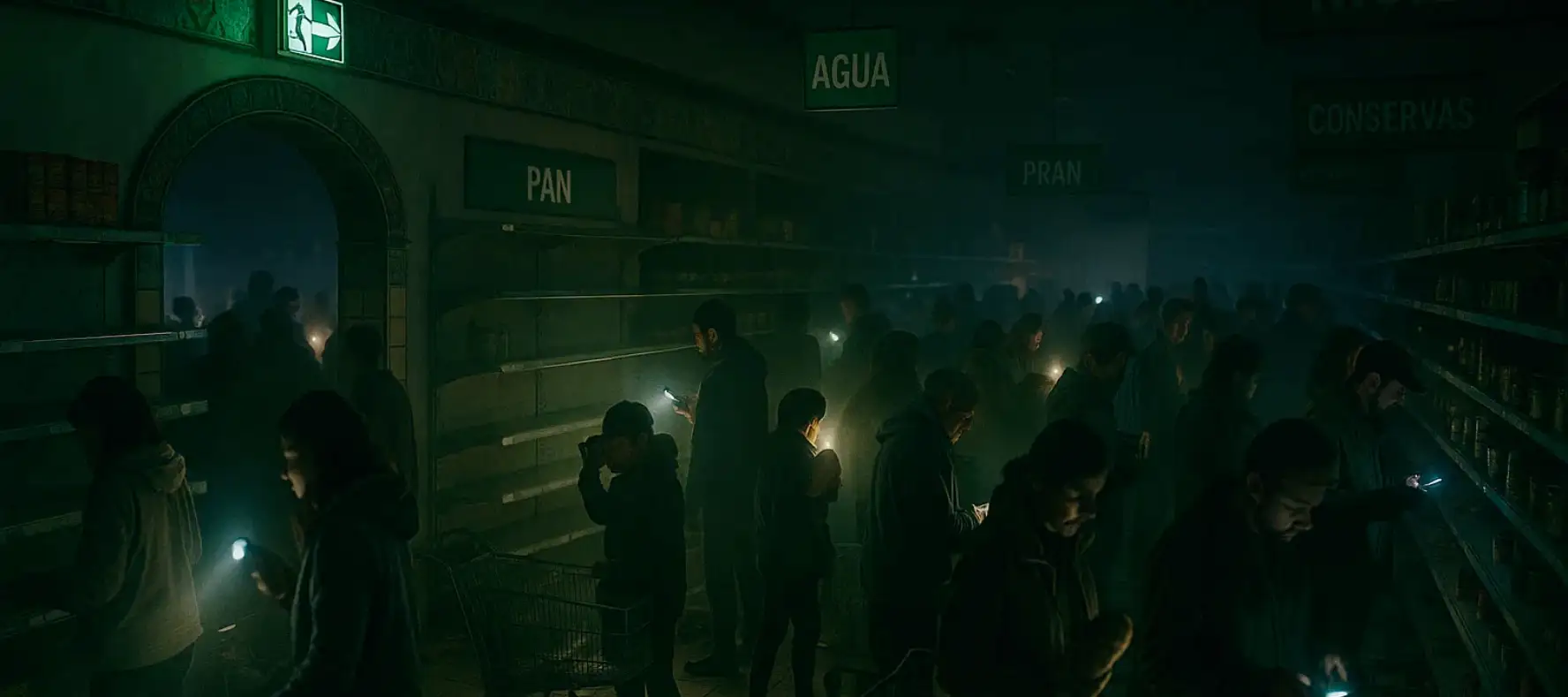
The power cut on the Costa Blanca hit town and country very differently. In Alicante we saw scenes that felt like a disaster movie: supermarkets that stayed open on emergency power were stormed. Panic buying was the order of the day – water in particular sold out fast. Queues formed at cash machines because card payments often didn't work. Traffic ground to a halt, traffic lights were dark, and tourists were stranded at the airport. The panic in the city was palpable, made worse by the loss of internet and mobile networks.
The mood in the rural parts of the Costa Blanca was completely different. In the villages around Elche and further south, life stayed remarkably relaxed. Restaurants that cook with gas opened their doors, and people enjoyed meals by candlelight. The calm in the countryside stood in sharp contrast to the hustle in Alicante. While the city sank into worry, people in the villages simply carried on with their day – proof of the easy-going attitude that shapes country life.
[BILD]Electricity & Gas in Spain: What You Need to Know
How does the electricity supply work in Spain, what does energy cost on the Costa Blanca and what should you watch out for when signing up? Everything important, explained compactly.
To the Electricity & Gas guide →Reactions and measures
The Spanish government reacted quickly with crisis meetings in Madrid. Pedro Sánchez called for calm and asked people to keep the 112 emergency number free for those who really needed it. Grid operator Red Eléctrica and Portugal's REN worked flat out, supported by electricity imports from France and Morocco. By the evening of 28 April, 20% of supply was back, and 75% by midnight. In Madrid people cheered when the lights came back on.
The Costa Blanca showed resilience too. Hospitals in Alicante and Valencia switched to emergency power, and the authorities coordinated supplies. European Council President António Costa stressed that there was no evidence of a cyberattack, which dampened speculation. Even so, the blackout exposed weaknesses in Europe's power grids, especially in the link between France and Spain.
City vs. countryside: what the blackout tells us about the Costa Blanca
The 2025 blackout made one thing clear: town and country experience crises differently. In densely populated cities like Alicante, the outage led to panic, uncertainty and a rush on supplies. Dependence on digital systems and infrastructure was especially noticeable here. In the countryside, by contrast, the strength of simplicity showed: less reliance on technology, a stronger sense of community and a relaxed attitude made the day easier to bear.
For expats on the Costa Blanca this is an important lesson. Living in a city like Alicante offers comfort and everything on your doorstep, but in a crisis it can get chaotic. Rural areas such as the villages around Elche offer peace and resilience, but often demand more self-reliance. Both lifestyles have their charm – it depends on what matters more to you. You'll find a good overview of the cost of living on the Costa Blanca – in the city and in the country – in our detailed guide.
Tips for expats and visitors
So that you're ready for future crises, here are some practical tips for life on the Costa Blanca:
- Cash: Always keep some cash to hand, as card payments can fail.
- Emergency kit: Torches, power banks and a battery-powered radio are essential.
- Supplies: Build up a small stock of water and long-life food, especially in the city.
- Network: Build contacts with your neighbours, whether in Alicante or in the countryside – community is worth its weight in gold in a crisis.
- Emergency plan: Know the nearest locations with backup power (e.g. hospitals) and important phone numbers.
In the long term it's worth questioning the region's infrastructure. The blackout showed that even a modern country like Spain is vulnerable. For expats, a small emergency generator or a solar power bank could be a sensible investment. If you haven't yet got to grips with electricity and gas in Spain, now is the time to do so.
Agree fixed meeting points and arrangements with family and neighbours in advance – e.g. “In a blackout we meet at home or at the neighbour's.” That way you stay connected even without a mobile signal.
Outlook: preparation is everything
The exact cause of the 2025 blackout is still unclear, but the events are a wake-up call. Energy experts such as Bruno Burger point to weak connections between France and Spain that made the problem worse. The Spanish government promised to hold private energy companies to account and to strengthen the grid. Until then, it's up to us to be prepared.
For the Costa Blanca this means: enjoy life, but be ready. Whether in the bustling city of Alicante or in the quiet villages, preparation makes the difference. The blackout was a test, and our region passed it, each in its own way.
Conclusion: the Costa Blanca remains a dream destination
The power cut on the Costa Blanca on 28 April 2025 was a shock, but also a chance to test our resilience. While Alicante fell into panic, the countryside showed its calm. For expats and visitors the message remains clear: the Costa Blanca is a wonderful place to live, but a little foresight makes everything easier. Were you on the Costa Blanca during the blackout? Did you experience the panic in Alicante or the calm in the countryside? Write to us – we'd love to hear your story.
Still have questions?
Carlo Reuß has 22 years of experience in emigrating, 10 of them in Spain. Got a question on this topic? Send it to us via the contact form.
Ask a question →Frequently asked questions about blackout emergency preparedness on the Costa Blanca
What is the most important preparation for a power cut on the Costa Blanca?
Make arrangements with your family in advance, e.g. “In a blackout we meet at home or at the neighbour's”. Keep an emergency plan with important contacts (e.g. hospital, 112) and a meeting point ready. Build a network with your neighbours, especially in the countryside near Elche, for mutual support.
How much water do I need for a blackout?
Plan on 3 litres of drinking water per person per day for drinking, cooking and hygiene (e.g. 36 litres for 4 people for 3 days). Store water in sealed containers in a cool, dark place so you're covered for 3–5 days, as the 2025 blackout showed.
What food should I have in stock for a power cut?
Keep long-life food for 3–5 days: tins (e.g. beans, tuna), dried fruit, pasta, rice or energy bars (approx. 2,000 calories per person per day). A camping stove with gas helps you prepare meals, especially in rural areas.
What equipment is essential for a blackout on the Costa Blanca?
Get torches with spare batteries, candles, a lighter, a power bank (at least 10,000 mAh), a battery-powered radio and a first-aid kit. Cash (at least €100 in small notes) is essential because card payments fail, as we saw in Alicante in 2025.
How do I stay mobile and safe during a blackout?
Keep your tank full or have a spare petrol can ready, as petrol stations can go down. Avoid driving because traffic lights are out. Use torches for getting around on foot and stick to your family arrangements, e.g. “We stay at home”, to avoid chaos.
How does communication work when networks go down during a blackout?
Use a battery-powered radio for official announcements (e.g. RNE). Charge power banks for emergency calls (112). Agree meeting points in advance, e.g. “If the network goes down, we meet at home in 2 hours”, so you stay connected without a mobile signal.
How does emergency preparedness differ between Alicante and rural villages?
In Alicante panic buying is common, so you need larger supplies (5 days) and cash. In the countryside (e.g. near Elche) neighbours often help each other, but shops are further away, so store water, food and petrol for 7 days. Emergency generators are useful in rural areas.
How can I prepare for power cuts on the Costa Blanca in the long term?
Invest in solar power banks or an emergency generator. Maintain a neighbourhood network and firm up your family emergency plans, e.g. by dividing up tasks. Find out about the local power infrastructure and keep supplies for at least 7 days.


Planning your move to the Costa Blanca?
Our guides cover the key steps — from the NIE number and residency to buying property.
Start with the NIE guidePersonal questions: new requests via the consultation page are currently paused.