


Region guide
Moving to Alicante
on the Costa Blanca
A cosmopolitan capital — the perfect base for your new life on the Costa Blanca
Ask a questionPlease note: new requests via the consultation page are currently paused.
366,000
Residents
5 million
Tourists a year
from €80k
Apartment prices
330
Sunny days a year
366,000
Residents
5 million
Tourists a year
from €80k
Apartment prices
330
Sunny days a year
Updated 20 November 2026 · About the author →
Living in Alicante — what to really expect
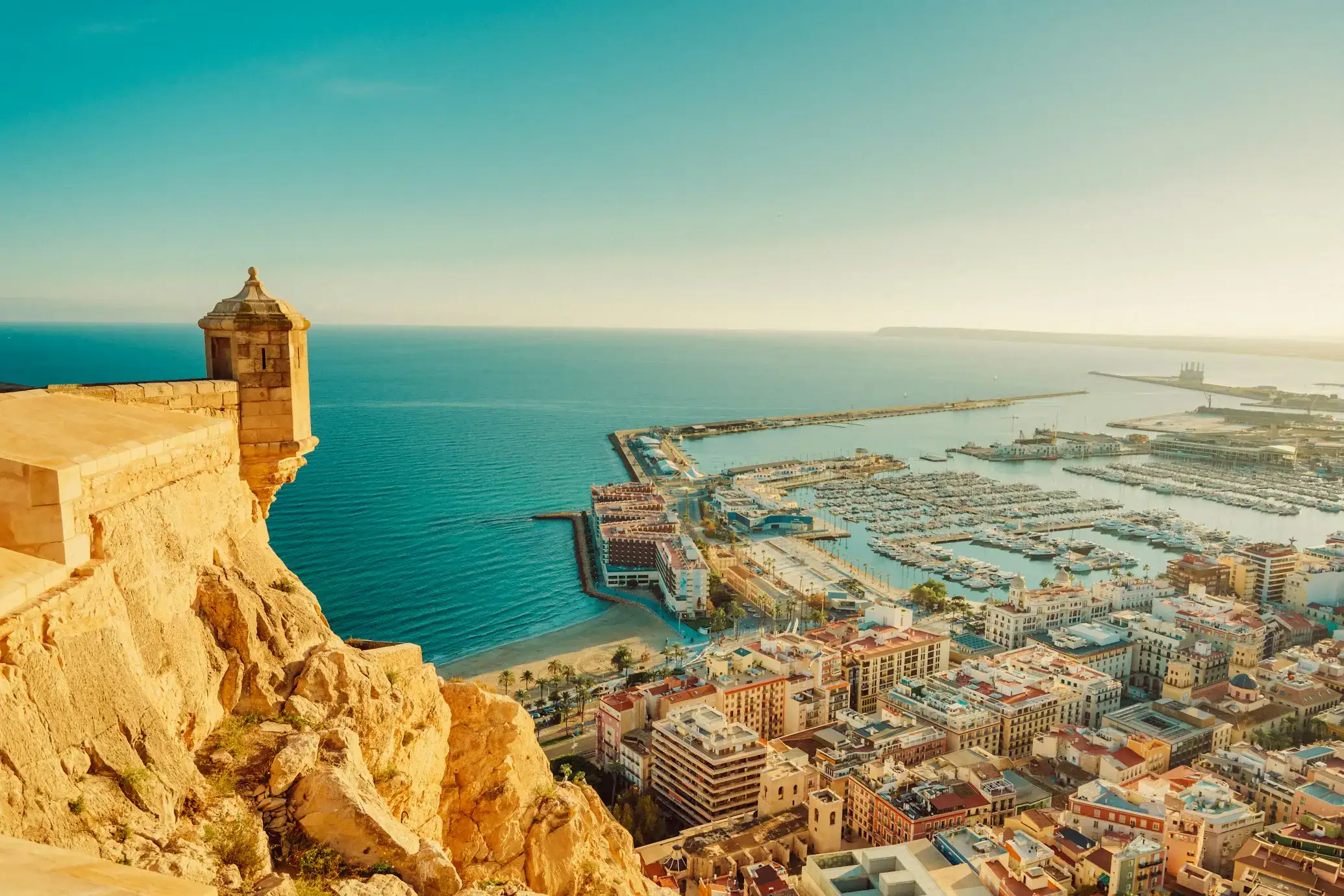
Alicante is the hotspot of the Costa Blanca — the largest city in the region, almost a small metropolis, yet with that unmistakable Spanish flair. Beautiful shopping streets, beach clubs right on the sea, a large marina, the impressive castle high above the city and the legendary market hall. Alicante welcomes around 5 million tourists every year — and anyone who lives here permanently understands why straight away.
This page takes you through everything that matters: from the first idea to your NIE number, from the housing market to residency. All based on real knowledge from 22 years living abroad, 10 of them in Spain.
The Explanada de España — the heart of Alicante
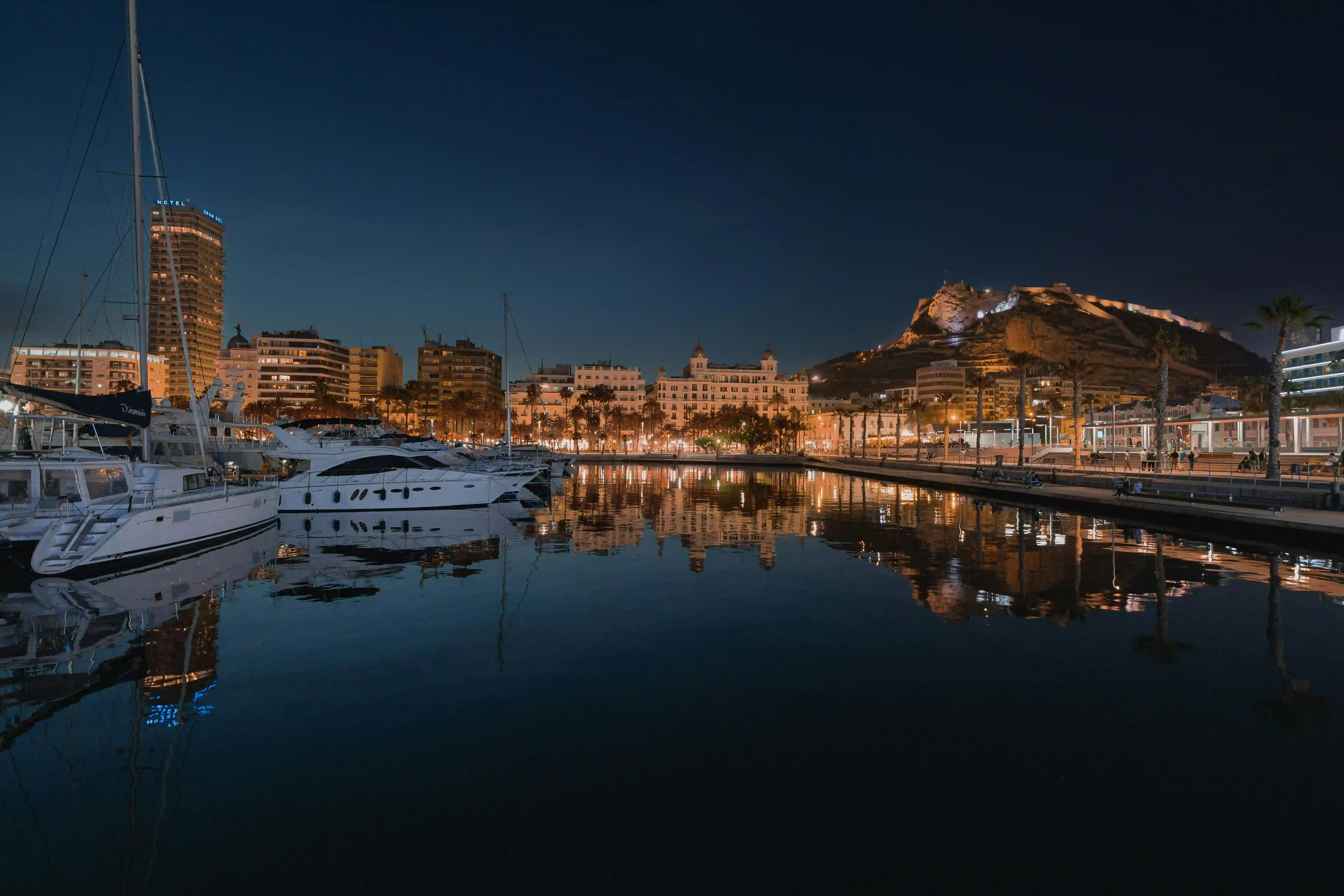
If you don't know Alicante yet, I always say: go to the Explanada. This 600-metre promenade right by the sea, paved with more than 6.5 million coloured mosaic tiles and lined with rows of tall palm trees, sums up life here. Strolling, eating tapas, watching the comings and goings at the marina — the Explanada is where Alicante celebrates itself. No wonder it is voted one of the most beautiful promenades in Europe year after year.
Around the Explanada you'll find first-class restaurants, lively tapas bars and the charming old town with its winding lanes. The market hall (Mercado Central) is an absolute highlight: fresh seafood, local vegetables, spices and regional specialities. Living here means shopping at the market in the morning and cooking fresh in the evening — a way of life you can't buy back home.
Neighbourhoods in Alicante — where do expats really live?
Alicante is bigger than many people think and is made up of very different neighbourhoods. The centre around El Barrio and the harbour is lively, but touristy in summer and correspondingly more expensive. If you want somewhere quieter and cheaper, look at La Florida or San Vicente del Raspeig — real Spanish city life, little tourism, stable rents. Families particularly like the area around El Campello, north of Alicante, not least because of the international schools there.
Cabo de las Huertas combines being close to the city with rocky coves and a calmer atmosphere — an insider tip for anyone who wants the best of both worlds. If you're looking for a tradesman or an electrician in Alicante, or other local service providers, take a look at our directory. The basic rule applies everywhere: the closer to the beach and the centre, the higher the rent and the purchase price — and that has become even more pronounced in recent years.
The Alicante rental market — the truth about holiday lets
I have to be honest here: the rental market in Alicante has become harder. As in Torrevieja or Benidorm, holiday letting has had a massive impact on the long-term market. Thousands of flats stand empty — not because nobody wants to move in, but because owners earn far more from Airbnb and holidaymakers than from long-term tenants. That pushes up both purchase prices and rents.
If you're moving to Alicante and looking for a long-term rental, you'll need patience and the right contacts. The official portals often show only a fraction of what is really available. Many good flats are let through networks and personal recommendations — local knowledge and personal contacts make a real difference in a tight market like this.
“Alicante is my tip for anyone who doesn't yet know where to start. You have everything on your doorstep — airport, public offices, beach, community. You can't go wrong here.”
Carlo Reuss — 22 years living abroad, 10 of them in Spain
Working in Alicante — ideal for employees
Of all the places on the Costa Blanca, Alicante offers the best job prospects for employees. The provincial capital has jobs in tourism, hospitality, IT, healthcare and international trade. If you speak English you'll get a long way in many sectors — Spanish is of course a plus, but not a must in international companies. For anyone who wants to work here as an employee, Alicante is clearly the best choice on the Costa Blanca.
Worth knowing: Spanish salaries are often lower than in northern Europe. If you arrive with the salary expectations of your home country, you'll have to adjust — unless you work in a very specialised field or remotely for a company back home. Remote work is booming: digital nomads and remote workers value Alicante for its airport, infrastructure and quality of life. Our guides to residency and taxes in Spain cover the basics for remote workers.
A tip: the castle and cruise ships — when to stay away
With the Castillo de Santa Bárbara, Alicante has one of the most impressive castles in Spain — high above the city with panoramic views over the harbour, old town and coast. My tip from personal experience: not in high summer. When the cruise ships dock — and there are more and more of them — thousands of day-trippers pour up to the castle at the same time. The queues for the lift are long, the temperatures brutal, the experience frustrating.
From October to May, on the other hand, you'll have the castle almost to yourself. Early in the morning or at sunset the view is unforgettable — and it's peaceful. That's my tip for Alicante in general: get to know the city at the right times. July and August, with up to 42 degrees and crowds in the centre, are exhausting. The rest of the year Alicante is one of the most pleasant cities in Europe.
NIE, residency and public offices in Alicante
For all things bureaucratic, Alicante is the best place to be on the whole Costa Blanca. The immigration office (Oficina de Extranjería), several police stations for the NIE and consulates are all in the city or close by. That sounds obvious — but it isn't. If you live in smaller towns such as Calpe or Altea, you'll have to drive to Alicante for many official appointments anyway.
The NIE (foreigner identity number) is the first step for everyone who moves here — without it nothing works in Spain: no bank account, no purchase contract, no mobile phone contract. Appointments at the responsible police station in Alicante are often quicker to get than you might think — if you know how. The same goes for residency: EU citizens register for the EU registration certificate, while non-EU citizens need a visa first and then a TIE card. Our NIE and residency guides explain the whole process step by step.
If you're not an EU citizen (UK, US …)
- Visiting is not living: without a visa you can stay in the Schengen area for up to 90 days in any 180-day period. Time spent on a Spanish residence permit or long-stay visa doesn't count towards that limit.
- To live in Alicante you need a Spanish visa or residence permit before you move — for example the non-lucrative residence visa, the digital nomad (international teleworking) visa or a work visa. Once in Spain you get your foreigner identity card, the TIE, from the Policía Nacional.
- UK nationals resident in Spain before 2021 are covered by the Withdrawal Agreement. The UK and Spanish governments recommend swapping the old green residency certificate for a TIE, which border staff recognise as proof of residence.
- Buying property no longer gives you residence: Spain ended the "golden visa" for property investors on 3 April 2025.
More in our guides to residency in Spain and the NIE number.
Sources (checked November 2026): GOV.UK – Spain entry requirements · GOV.UK – Spain: register your residency · La Moncloa – end of the golden visa. Rules change — check the current requirements before you apply.
Questions about Alicante?
New requests via the consultation page are currently paused — the page has the details.
Consultation page🏡 Buying support
Buying property in Alicante? How personal support works, from the search to the keys.
Learn moreQuick links
Everything you need for Alicante
From planning to everyday life — all the key topics for your move
📋
🪪
🏡
🚗
🏥
💼
💶
🔌
⚖️
Get your NIE number
The first step — without an NIE nothing works in Spain.
Register as a resident
When you have to register and how it works — EU and non-EU.
Buying property
Buying property in Spain explained step by step.
Register your car
Re-registering a car in Spain — process, costs, deadlines.
Health insurance
Public or private — what really applies in Spain.
Self-employed in Spain
Autónomo or SL — explained step by step.
Taxes in Spain
What you pay tax on as a resident.
Electricity & gas
Setting up utility contracts quickly and without stress.
Lawyer & gestoría
When you need help and where to find it.
What's on
Events & weekly markets in Alicante
Markets, fiestas and events in your area
🛒
Sat 21 Nov
8 am – 2 pm
Alicante Weekly Market – Mercadillo Teulada
📍 Alicante · Calle Teulada / Avenida...
🛒
Sun 22 Nov
8 am – 3 pm
El Campello Weekly Market (Sunday)
📍 El Campello · Avinguda Ausiàs March
🎨
Sun 22 Nov
10 am – 3 pm
Alicante Old Town Craft Market
📍 Alicante · Plaza de la Santísima Faz...
🛒
Wed 25 Nov
6:30 am – 1 pm
El Campello Weekly Market (Wednesday)
📍 El Campello · Plaza Saint Christol lez...
🛒
Wed 25 Nov
8 am – 1:30 pm
Mutxamel Weekly Market
📍 Mutxamel · Avenida Carlos Soler
🛒
Thu 26 Nov
8 am – 2 pm
Alicante Weekly Market – Mercadillo Teulada
📍 Alicante · Calle Teulada / Avenida...
📅
Fri 27 Nov
11 am – 9 pm
Mercado de Navidad Alicante 2026 (Alicante Christmas Market)
📍 Alicante · Paseo de Federico Soto
📅
Sat 28 Nov
11 am – 9 pm
Mercado de Navidad Alicante 2026 (Alicante Christmas Market)
📍 Alicante · Paseo de Federico Soto
🛒
Sat 21 Nov
8 am – 2 pm
Alicante Weekly Market – Mercadillo Teulada
📍 Alicante · Calle Teulada / Avenida...
🛒
Sun 22 Nov
8 am – 3 pm
El Campello Weekly Market (Sunday)
📍 El Campello · Avinguda Ausiàs March
🎨
Sun 22 Nov
10 am – 3 pm
Alicante Old Town Craft Market
📍 Alicante · Plaza de la Santísima Faz...
🛒
Wed 25 Nov
6:30 am – 1 pm
El Campello Weekly Market (Wednesday)
📍 El Campello · Plaza Saint Christol lez...
🛒
Wed 25 Nov
8 am – 1:30 pm
Mutxamel Weekly Market
📍 Mutxamel · Avenida Carlos Soler
🛒
Thu 26 Nov
8 am – 2 pm
Alicante Weekly Market – Mercadillo Teulada
📍 Alicante · Calle Teulada / Avenida...
📅
Fri 27 Nov
11 am – 9 pm
Mercado de Navidad Alicante 2026 (Alicante Christmas Market)
📍 Alicante · Paseo de Federico Soto
📅
Sat 28 Nov
11 am – 9 pm
Mercado de Navidad Alicante 2026 (Alicante Christmas Market)
📍 Alicante · Paseo de Federico Soto
Alicante — an honest overview
Pros and cons from real life — not marketing
Advantages of Alicante
✓
Direct flights from all over Europe — every day
✓
Best infrastructure on the Costa Blanca
✓
Most affordable property prices by comparison
✓
International schools available
✓
Beach right in the city centre (Postiguet)
✓
Large international community
Worth knowing
!
City centre packed in summer
!
Extreme heat in July/August (up to 42 °C)
!
Less quiet, rural feel than the north
!
Lots of construction in growth areas

Housing market in Alicante
Current market prices for buying and long-term renting in Alicante and the surrounding area. All figures are guide values — location, condition and sea views have a big effect on the price.
Rent, 1-bed flat
€550–900/month
Rent, 2-bed flat
€750–1,300/month
Buy from
from €80,000
Buy, price per m²
€1,200–2,500/m²
Good supply of long-term rentals — one of the largest rental markets on the Costa Blanca.
Buying property in Alicante
Buying property in Spain involves a few things to watch: the NIE number, a land registry extract, checking the property is free of debts and charges, the notary — and budgeting 10–13% for purchase costs on top of the price. Our buying guide explains each step.
Compare other areas
The Costa Blanca has many faces — discover more towns
Frequently asked questions about Alicante
From real life — the questions we hear most often
Which neighbourhoods in Alicante are most popular with expats?
Many expats live in La Florida, Cabo de las Huertas, San Vicente del Raspeig or the city centre. Families particularly like the area around El Campello, which has an international school.
How well connected is Alicante by air?
Excellent — Alicante-Elche airport has direct flights all year round to cities across Europe: the UK and Ireland, Scandinavia, the Netherlands, Germany (Berlin, Munich, Frankfurt, Hamburg, Düsseldorf) and many more. Low-cost airlines such as Ryanair fly to Alicante regularly.
What does it cost to live in Alicante?
One person can live well on €1,500–2,000 a month. Rent for a two-bedroom flat starts at €750, and groceries are noticeably cheaper than in much of northern Europe (around 30% less than in Germany, for example).
Do I need to speak Spanish in Alicante?
In international neighbourhoods you can get by in everyday life without Spanish. For dealing with the authorities and for settling in long term, though, learning Spanish is strongly recommended.
Where can I find an electrician or plumber in Alicante?
Electricians, plumbers and other tradespeople in Alicante are best found through recommendations from the local international community or expat groups. Our directory and our guides to tradespeople and electricians are a good starting point. Always ask for a written quote (presupuesto).
What does it cost to move to Alicante?
A removal from central Europe (from Germany, for example) costs between €2,000 and €6,000, depending on the volume of your household. On top of that come registration costs (NIE, residency), a possible rental deposit and, if you buy, notary and purchase costs. Careful planning pays off.
Tradespeople & services in Alicante
Guides to finding local services on the Costa Blanca
🔌Electricians
🔧Plumbing & pools
🏗️Tradesmen
🚛Removals to Alicante
🏥Health insurance
⚖️Lawyer & gestoría
💼Taxes in Spain
🏡Estate agents
📒Local directory
Looking for an electrician, plumber or tradesman in Alicante?
Whether it's an electrician in Alicante, a plumber, a painter or help with your move — finding the right contacts is the hardest part. Recommendations from the local community are worth a lot; our directory and service guides are a good place to start. Always ask for a written quote (presupuesto) before work begins.
Browse the directory →Ready for your life in Alicante?
From the NIE number to moving in — our guides take you through every step, based on 22 years living abroad, 10 of them in Spain.
Personal questions: new requests via the consultation page are currently paused.