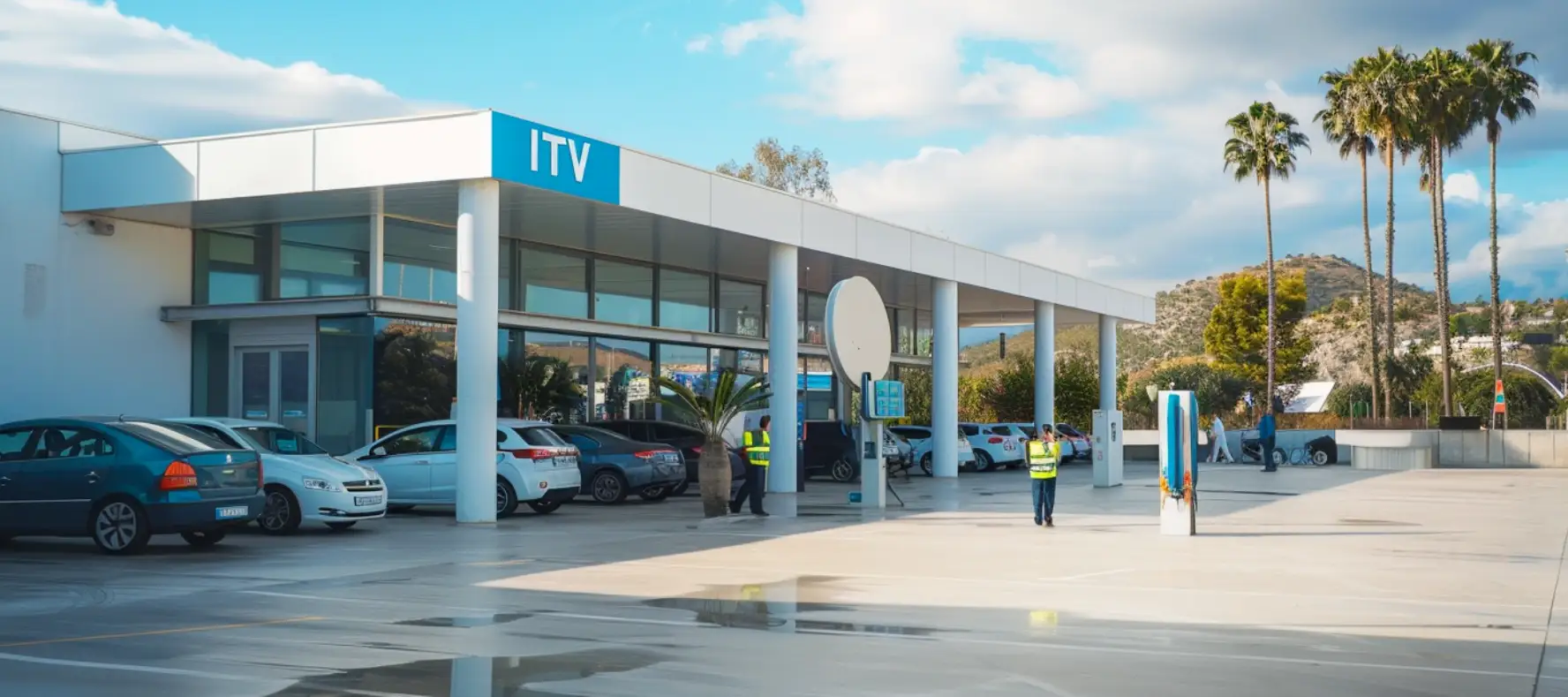
The ITV ("Inspección Técnica de Vehículos") is Spain's equivalent of a roadworthiness test such as the UK MOT or the German TÜV, and it is compulsory for all vehicles in Spain. On the Costa Blanca there is often uncertainty about how the appointment works, which documents are needed and what the differences are between a regular periodic ITV and the inspection of an imported vehicle.
This guide explains clearly and practically how a visit to the ITV works – from the costs and the technical procedure to booking appointments. It also presents the main ITV stations in the province of Alicante, with notes on booking appointments. The particularities of importing a vehicle, such as the ficha técnica reducida (reduced technical data sheet) or collecting the blue ITV card, are also explained clearly.
The article is aimed at all vehicle owners on the Costa Blanca who have their first ITV appointment ahead of them or who want to import a foreign vehicle into Spain.
What is the ITV in Spain?
The ITV ("Inspección Técnica de Vehículos") is the official technical vehicle inspection in Spain and corresponds to tests such as the UK MOT or the German TÜV. Every vehicle registered in Spain has to pass this inspection at regular intervals in order to stay on the road. The intervals depend on the age and type of vehicle: new vehicles have a longer period before their first test, older vehicles have to be checked more frequently.
The inspection ensures that the vehicle is technically sound and that all safety-relevant systems work correctly. These include brakes, steering, suspension, lights, tyres, emissions and conformity with the registered technical data. The ITV is regulated uniformly throughout Spain, but waiting times, appointment booking and organisation can differ slightly from station to station.
On the Costa Blanca there are numerous modern ITV stations that carry out both regular inspections and the technical approval of imported vehicles. The next section explains how a normal ITV inspection works and what it typically costs.
ITV comparison: regular inspection vs. vehicle import
Regular ITV in Spain
Which vehicles?
Vehicles already registered in Spain with Spanish number plates.
Inspection intervals (private cars)
- up to 4 years: no ITV required
- 4–10 years: every 2 years
- from 10 years: every year
Procedure on site
- Drive to the ITV station, normally with an appointment booked online in advance (sitval.com)
- Called over the loudspeaker (number plate + inspection lane)
- Check of lights, brakes, suspension, steering, emissions, tyres, underbody
- Usually takes approx. 10–20 minutes
Documents required
- Vehicle registration document / Spanish registration
- ITV report from the last inspection (if available)
- ID card / NIE
- Proof of insurance if required
Costs (Valencian Community, car, incl. VAT and DGT fee, 2025 tariff)
- Petrol with catalytic converter: around €41.50
- Diesel: around €56 (current tariffs on sitval.com)
Result
- ITV sticker for the windscreen
- Inspection report, which should be kept in the vehicle
In Germany, for example, a car usually has to have its first roadworthiness test (HU) after 3 years and then every 2 years – costing on average around €160 for the HU incl. emissions test in 2026, according to the German automobile club ADAC. In Spain, the ITV for private cars only starts after 4 years, then every 2 years and only annually from 10 years. For newer vehicles this means more peace of mind, and for older cars the annual check is a clear safety advantage: defects are detected early, without the individual inspections being as expensive as in Germany.
ITV for imported vehicles
Which vehicles?
Vehicles with foreign number plates that are to be newly registered in Spain.
Purpose of the inspection
- Technical approval for the first Spanish registration
- Check of the chassis number (VIN) and technical data
- Creation or confirmation of the technical data for Spain
Additional documents
- Foreign registration certificate, Parts I & II (EU format)
- Ficha técnica reducida (reduced technical data sheet)
- ID card / NIE
- Certificate of registration with the town hall (empadronamiento) if required
- Purchase contract or proof of ownership (recommended)
Procedure on site
- Registering the import vehicle at the station
- Document check and comparison of the vehicle data
- Technical inspection similar to the regular ITV
- Usually takes approx. 20–30 minutes
Costs (import ITV)
- ITV fee for imported vehicles: higher than for a regular ITV – ask SITVAL or the station for the current tariff
- Other costs (taxes, registration, number plates) are charged separately
After the appointment
- Inspection report and sticker usually issued immediately
- The blue Spanish ITV card (tarjeta ITV) is often only ready after a few days and is collected from the station
- Then: visit to the traffic authority, tax payment, insurance, number plates made
The right car insurance for your car in Spain
After the ITV you need Spanish car insurance. Find out which options there are and what to look out for.
To the insurance guide →Procedure for the regular ITV (vehicles already registered in Spain)
For the regular ITV in the Valencian Community you normally book an appointment (cita previa) online in advance at sitval.com. Whether a station also accepts vehicles without an appointment varies and changes – vehicles with an appointment are called first in any case. As soon as your number plate is announced over the loudspeaker, you're told which inspection lane to drive into.
The actual technical check mostly takes place with you in the vehicle and is fully guided by the staff. Among other things, lights, brakes, steering, axles, exhaust emissions, tyres, underbody and other safety-relevant items are checked. The staff show you everything step by step – if there's a language barrier, they do many of the steps themselves.
A regular ITV typically takes 10 to 20 minutes. Once you've passed, you immediately receive the new sticker and the written report.
Procedure for the ITV for imported vehicles
For the technical approval of a vehicle from abroad, the appointment starts with an extended document check. The registration certificate (Parts I and II), the ficha técnica reducida as well as identity and ownership are checked. The vehicle is then compared with the technical data submitted – in particular the chassis number, engine and dimensions.
The technical inspection itself is similar to a regular ITV but takes a little longer, as additional data has to be recorded and confirmed. Here, too, the staff actively help, especially if a driver isn't yet familiar with the procedure. The technical part usually takes 20 to 30 minutes.
After the inspection you receive the detailed inspection report and the ITV sticker. The final Spanish ITV card ("tarjeta ITV") is in many cases only issued a few days later and then has to be collected from the station. Only with this card can the vehicle be registered with the Spanish traffic authority. If you want to fully register your vehicle in Spain, you'll find all further steps explained there.
ITV stations on the Costa Blanca
The province of Alicante has a well-developed network of ITV stations, spread from the northern Costa Blanca to the Torrevieja area in the south. Every station works to the same legal requirements but differs in organisation, appointment availability and waiting times. Most stations are run by SITVAL, the public company of the Valencian regional government; appointments are booked online at sitval.com. Whether a station also inspects without an appointment varies – check on sitval.com or by phone first.
To help vehicle owners quickly find the right station, the next section contains an overview of the main ITV locations in the province of Alicante with address, region and Google Maps link (without guarantee – the current station list on sitval.com is what counts). This overview makes planning easier and shows at a glance which station best suits your home town or an import appointment.
ITV Alcoy
Region: Costa Blanca inland / north
Address:
Polígono Industrial Santiago Payá, C. Filà Navarros, 03802 Alcoy
Appointment: book online in advance (sitval.com) or ask the station
ITV Alicante (Pla de la Vallonga)
Region: Alicante city / central Costa Blanca
Address:
Carretera de Ocaña, Km 1, 03007 Alicante
Appointment: book online in advance (sitval.com) or ask the station
ITV Benidorm
Region: Northern Costa Blanca
Address:
Partida Salto del Agua, 35, 03503 Benidorm
Appointment: book online in advance (sitval.com) or ask the station
ITV Elche
Region: Southern Costa Blanca
Address:
Carrer Faisà, 18, 03203 Elx / Elche
Appointment: book online in advance (sitval.com) or ask the station
ITV Novelda
Region: Costa Blanca inland
Address:
Polígono Industrial El Fondonet, 03660 Novelda
Appointment: book online in advance (sitval.com) or ask the station
ITV Ondara
Region: Northern Costa Blanca (near Denia)
Address:
Partida Tossals, 81B, 03760 Ondara
Appointment: book online in advance (sitval.com) or ask the station
ITV Orihuela
Region: Southern Costa Blanca / inland
Address:
CV-870, Km 0, 03300 Orihuela
Appointment: book online in advance (sitval.com) or ask the station
ITV Pilar de la Horadada
Region: Southern Costa Blanca
Address:
Calle Alcarria, 34, 03190 Pilar de la Horadada
Appointment: book online in advance (sitval.com) or ask the station
ITV Redován
Region: Southern Costa Blanca
Address:
Polígono Industrial de Redován, C. Guillermo Rocamora, 03370 Redován
Appointment: book online in advance (sitval.com) or ask the station
ITV Torrevieja
Region: Southern Costa Blanca
Address:
Ctra. CV-905 Torrevieja - Crevillente, Km. 5.4, 03184 Torrevieja
Appointment: book online in advance (sitval.com) or ask the station
ITV Villena
Region: Costa Blanca inland
Address:
Polígono Industrial Bulilla, C. 7, 03400 Villena
Appointment: book online in advance (sitval.com) or ask the station
What is the ficha técnica reducida?
The ficha técnica reducida is a technical data sheet that is mandatory when importing a vehicle into Spain. It contains all the relevant technical information the Spanish authorities need for the first registration – including dimensions, axle loads, engine, emission standards, weight data and other specifications. Without this document, neither the import ITV can be completed nor the Spanish registration applied for.
Many vehicles already have this document as an A4 sheet among their papers. It's often found in the owner's manual, the service book or separately with the manufacturer's technical documents. With older vehicles or those that have been re-registered several times, however, it is quite often missing entirely.
If you don't have the ficha técnica, there are basically two options: you can request it directly from the vehicle manufacturer, which in many cases costs often several hundred euros, depending on the manufacturer, and sometimes involves long waiting times. Alternatively, the document can be produced online by specialised technical engineering firms. This is possible, but often complicated, as lots of photos, details and technical data are needed.
For many owners of imported vehicles it's therefore worth having the situation checked in advance. A gestoría or technical office can use the vehicle data to clarify which document is really needed and the quickest way to obtain it.
If you bring your vehicle to Spain as part of your household goods when moving, you can often avoid the import (registration) tax of up to around 14.75% of the vehicle's value altogether. However, clear conditions apply: as a rule, the car must have been in your possession for at least 6 months before the move, and the tax exemption must be applied for within a limited time window after changing your residence. If you miss these deadlines, you pay tax unnecessarily. If you're planning to move permanently to the Costa Blanca with your own car, you should therefore think through the process early on: first plan your move and residence status, then time the vehicle import so that all the conditions for the tax exemption are met.
How re-registering an imported vehicle in Spain works
ITV import inspection
Technical approval of the foreign vehicle: identity check, comparison of the chassis number, technical inspection and check of the ficha técnica reducida.
After the appointment: inspection report & sticker immediately, the Spanish ITV card ("tarjeta ITV") often only ready for collection after a few days.
Check the tax (impuesto de matriculación)
Depending on the vehicle model, emissions and your personal situation, the registration tax can be up to about 14.75% of the vehicle's value – or not apply at all if the car is recognised as household goods from a move.
Whether the tax is due, and how much, should be clarified before the next steps.
Take out insurance
To register Spanish number plates you need valid Spanish car insurance. Many insurers accept the ITV report together with the foreign vehicle documents for this.
Registration with the DGT (traffic authority)
With all the documents — ITV, tarjeta ITV, proof of insurance, tax receipt (if required), ID/NIE — the vehicle is officially registered on Spanish plates at the DGT (Dirección General de Tráfico).
Once processed, you receive the Spanish registration certificate (permiso de circulación).
Have number plates made & fitted
Finally, the new Spanish number plates are made and fitted to the vehicle.
From this moment on, the car is fully registered in Spain and may be used on the road as normal.
Conclusion: mastering the ITV on the Costa Blanca
The ITV on the Costa Blanca is easier to handle than many newcomers think. If you know the procedure, have the right documents ready and choose the right station, you'll get through the Spanish vehicle inspection without problems – both with the regular test and with an imported vehicle.
It's important to understand the differences between the regular ITV and the import ITV: for vehicles registered in Spain, what counts above all is the technical condition, while for imports, documents such as the ficha técnica reducida, the tax (impuesto de matriculación), insurance and the subsequent registration with the DGT also play a major role. If you plan cleverly, you can even avoid the import tax by importing the vehicle correctly as household goods from your move.
With the station overview, the appointment notes, cost information and the complete re-registration process, you're well prepared. If you have a question, you can send it to us via the contact form. For the basic dealings with the authorities, such as applying for an NIE number or registering for the residencia, you'll also find detailed guides on our site.
Re-registering your car in Spain
From the ITV to Spanish number plates: all the re-registration steps at a glance.
To the guide →Frequently asked questions about the ITV on the Costa Blanca
How often does my car have to go for the ITV in Spain?
For private cars in Spain the general rule is: no ITV is required in the first four years after first registration. From year 4 to 10 the vehicle has to go for the ITV every two years, and from the age of ten an annual inspection is compulsory. Compared with Germany, for example, this means longer breaks for newer cars and shorter intervals for older vehicles – which increases road safety.
How much does the ITV cost on the Costa Blanca for petrol and diesel cars?
Costs vary slightly depending on the station and vehicle type. In the Valencian Community the 2025 tariff for a petrol car with catalytic converter was around 41.50 euros and for a diesel around 56 euros (incl. VAT and DGT fee). The special approval for imported vehicles costs more. Current tariffs are on sitval.com.
Do I always need an appointment for the ITV or can I just turn up?
In the Valencian Community you normally book an appointment (cita previa) online in advance at sitval.com. Whether a station also accepts vehicles without an appointment varies from station to station and changes – check first. With an appointment you are called first.
Which documents do I need for a regular ITV in Spain?
For a regular ITV of a vehicle registered in Spain you generally need: the Spanish registration certificate (permiso de circulación), the previous ITV report (if available), ID or NIE number and, in some cases, proof of insurance. It's worth bringing all vehicle documents both as copies and originals so that any questions can be answered quickly.
What is the ficha técnica reducida and when do I need it?
The ficha técnica reducida is a technical data sheet containing all vehicle data relevant for Spain (including dimensions, axle loads, weight, engine and emission standard). It is mainly needed when a foreign vehicle is to be registered in Spain for the first time. Without this document, the ITV for imported vehicles and the subsequent registration with the DGT usually cannot be completed. If there is no ficha técnica, it can be obtained from the manufacturer or produced by specialised engineering firms – which, depending on the route, costs a few hundred euros. An individual check in advance helps to find the most sensible and cheapest way.
Can I go to the ITV if I hardly speak any Spanish?
Yes, in principle that's possible. The technical procedure in the inspection lane is clearly guided by the staff, and the inspectors do many of the steps themselves. Still, it helps to prepare a few basic terms and short phrases in Spanish – especially with imported vehicles, if questions about documents or the ficha técnica come up. If you feel unsure, you can arrange support in advance.
What happens if my vehicle fails the ITV?
If defects are found during the ITV, they are documented in the inspection report. With minor defects the vehicle can often still be used, as long as the re-inspection takes place within a set deadline. With serious defects, use of the vehicle may be restricted or prohibited until the repair has been carried out. The re-inspection usually takes place at the same station and is often considerably cheaper than the first inspection.
How does re-registering an imported vehicle in Spain work?
Re-registering an imported vehicle involves several steps: first comes the special ITV import inspection with technical approval and issue of the tarjeta ITV. Next, it's checked whether registration tax (impuesto de matriculación) is due or whether the vehicle can be registered with tax relief as household goods from a move. Then Spanish car insurance is taken out before the vehicle is registered with the DGT and fitted with Spanish number plates. Following the right order saves time, money and nerves.



Planning your move to the Costa Blanca?
Our guides cover the key steps — from the NIE number and residency to buying property.
Start with the NIE guidePersonal questions: new requests via the consultation page are currently paused.