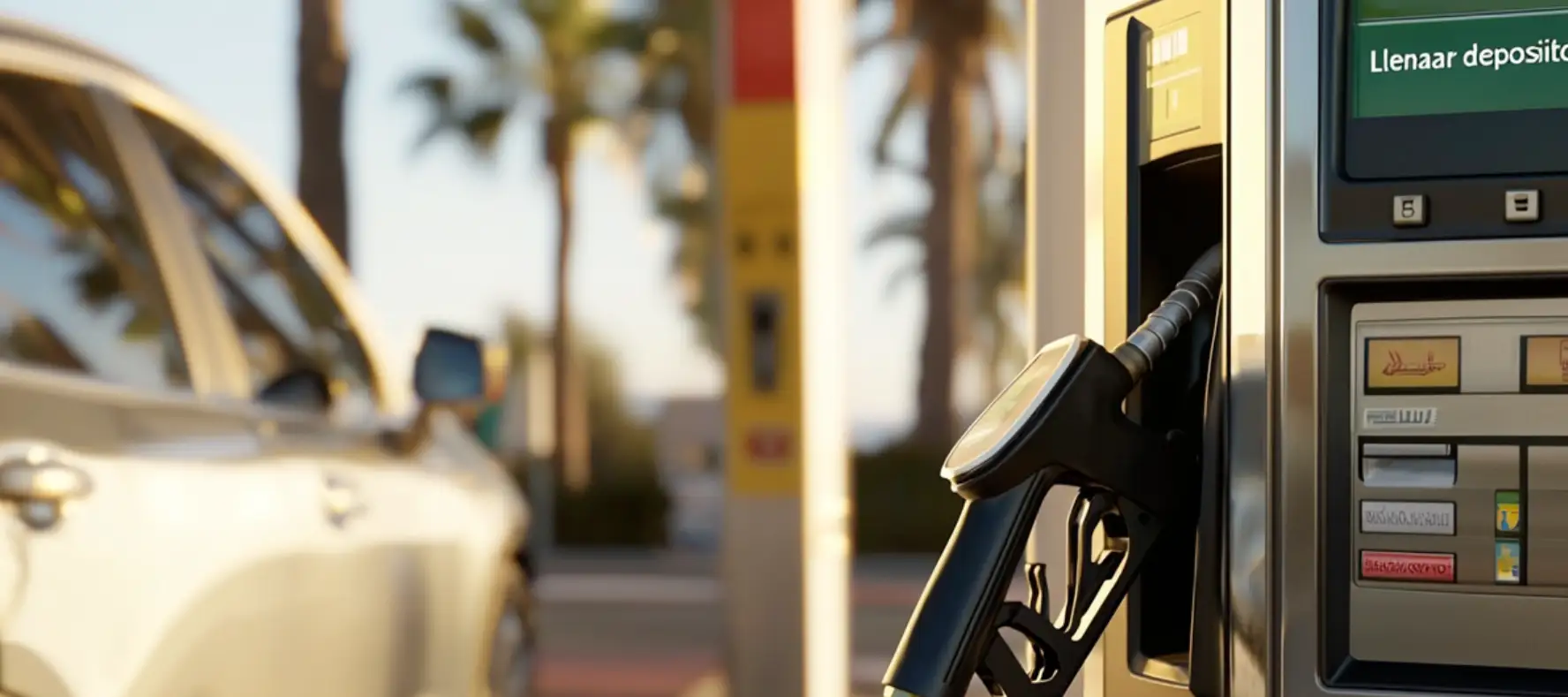
If you're driving around the Costa Blanca, you'll soon notice: filling up in Spain works a little differently from what you may be used to at home. Above all, so-called self-service petrol stations are widespread here – and they bring not only a real price advantage but, for many people, a bit of uncertainty at first. How does it actually work without staff? What happens if something goes wrong? And why is fuel so much cheaper there? In this article I'll explain everything you need to know about filling up in Spain – focusing on the difference between self-service and classic staffed petrol stations. You'll get a simple step-by-step guide, real price comparisons (as of April 2025) and practical tips for expats and tourists on the Costa Blanca.
What is a self-service petrol station – and why is it so much cheaper?
Self-service petrol stations (in Spanish: "gasolineras autoservicio" or "low cost") are fully automated. No shop, no staff, no coffee machine – just pumps and a payment terminal. Sounds like a discount petrol station? That's exactly what it is – and you notice it in the price.
In April 2025 (when we checked), petrol 95 at self-service stations in Crevillente and the surrounding area cost about 1.25 to 1.35 euros per litre. Current prices for every station are shown on the official fuel-price map of Spain's energy ministry (geoportalgasolineras.es). At classic staffed stations such as Repsol or Cepsa, on the other hand, you often pay between 1.50 and 1.60 euros per litre. So the difference can be up to 35 cents per litre! If you drive a lot, you can quickly save several hundred euros a year.
The reason for the low prices is simple: the operators save on staff and running costs and pass the advantage on to you. At the same time, you can fill up quickly, easily and around the clock. Sure, sometimes you still have to queue – especially at peak times. But that's no different at classic petrol stations.
How to fill up at Spanish fuel machines
Many people standing at a self-service petrol station in Spain for the first time feel unsure. Don't worry – with this step-by-step guide, filling up is stress-free:
Park & choose your language: at the terminal you first choose the language. English (often also German) is usually available, otherwise Spanish.
Choose the pump: enter the number of your pump (clearly visible on the pump itself).
Choose an amount or "fill up": you can choose a fixed amount (e.g. 20 euros) or the "fill up" option (usually "Llenar depósito"). In that case, your card is pre-authorised for a security amount (usually 150 euros). Later, however, only the actual amount is charged.
Pay: you pay by debit or credit card. Cash is rarely possible. As soon as the payment is authorised, the pump is released.
Fill up & take your receipt: fill up as normal and collect your receipt from the terminal at the end. If you need a proper invoice (factura), you can usually request it online (e.g. at plenoil.es/factura).
Sounds easy? It is! And if something does go wrong: many machines have a help button or a phone number for support.
Before you set off, it's worth checking apps such as "GasAll" or "Precio de la gasolina" – they show you the cheapest petrol stations in your area in real time.
Car insurance in Spain
Everything you need to know about car insurance in Spain – from re-registering your car to the right policy for your everyday life on the Costa Blanca.
To car insurance →Is there E10 in Spain? And what fuel do I actually use?
Another important point many newcomers don't know: E10 is permitted in Spain but only sold at very few petrol stations. Here you usually simply fill up with "Gasolina 95" (unleaded 95, normally E5 – the E5/E10 label is on the pump) or "Gasolina 98" (for more powerful vehicles).
If you drive a diesel, look for the label "Diesel" or "Gasóleo A", depending on the petrol station.
Everything is clearly labelled at the pumps, but if you're unsure, the rule is: when in doubt, always Gasolina 95. If you're sorting out your car anyway, you'll find more useful information about driving on the Costa Blanca on the page about car insurance in Spain.
Self-service or staffed station? A direct comparison
Here's a direct comparison between self-service and classic petrol stations:
Tips for expats & holidaymakers on the Costa Blanca
Especially if you're new to Spain or driving a hire car, these tips will help:
- Don't leave filling up to the last minute – a self-service station may be out of order or not accept your card.
- Apps such as "GasAll" or "Precio de la gasolina" show you the cheapest petrol stations nearby.
- Avoid peak times, e.g. 8 am or Saturday afternoons.
- Always take your receipts, especially if you need an invoice or are travelling.
- Fuel cards & discount apps: many providers offer extra discounts via apps or loyalty schemes – well worth it if you drive a lot.
If you live on the Costa Blanca permanently, you should also keep an eye on the cost of living in Spain – fuel prices are just one item among many. If you still need to re-register your car, you'll find all the steps on the page about registering your car in Spain. And if you're still at the beginning of your move, the overview of the residencia (TIE) (residence registration and foreigner ID card) will help.
Conclusion: filling up cheaply on the Costa Blanca is easy
Self-service fuelling in Spain sounds unfamiliar at first, but it really is easy once you know the process. You save hard cash, don't have to worry about opening hours and can fill up with a few taps whenever you like. For expats and frequent drivers in particular, that's a real advantage. And once you've got the hang of it, you probably won't want to go back to the classic petrol station.
So: don't be afraid of the machine – card in, fill up, save money – and off you go through the Costa Blanca sunshine!
Frequently asked questions
Can I pay cash at a self-service petrol station in Spain?
As a rule, no. Self-service petrol stations in Spain accept almost exclusively debit and credit cards. Cash is only very rarely possible, so it's best to always carry a working card.
What does pre-authorisation mean when filling up the tank?
If you choose "fill up", the system first reserves a security amount – usually 150 euros – on your card. In the end, however, only the amount you actually filled up is charged. The reservation is usually released within a few days.
Is E10 fuel available on the Costa Blanca?
Hardly: E10 is permitted in Spain but only sold at very few stations. The standard is Gasolina 95 (normally E5, labelled on the pump). For more powerful vehicles there is Gasolina 98. Diesel is labelled "Gasóleo A" or simply "Diesel".
How do I get an invoice (factura) from a self-service petrol station?
You get a simple till receipt directly at the terminal. With most operators you can request an official invoice with your NIF (tax identification number) online afterwards – for example via the operator's website.
How do I find the cheapest petrol station near me on the Costa Blanca?
Apps such as "GasAll" or "Precio de la gasolina" show you the current prices of all petrol stations in your area in real time. That way you can quickly find the cheapest option before you set off.



Planning your move to the Costa Blanca?
Our guides cover the key steps — from the NIE number and residency to buying property.
Start with the NIE guidePersonal questions: new requests via the consultation page are currently paused.