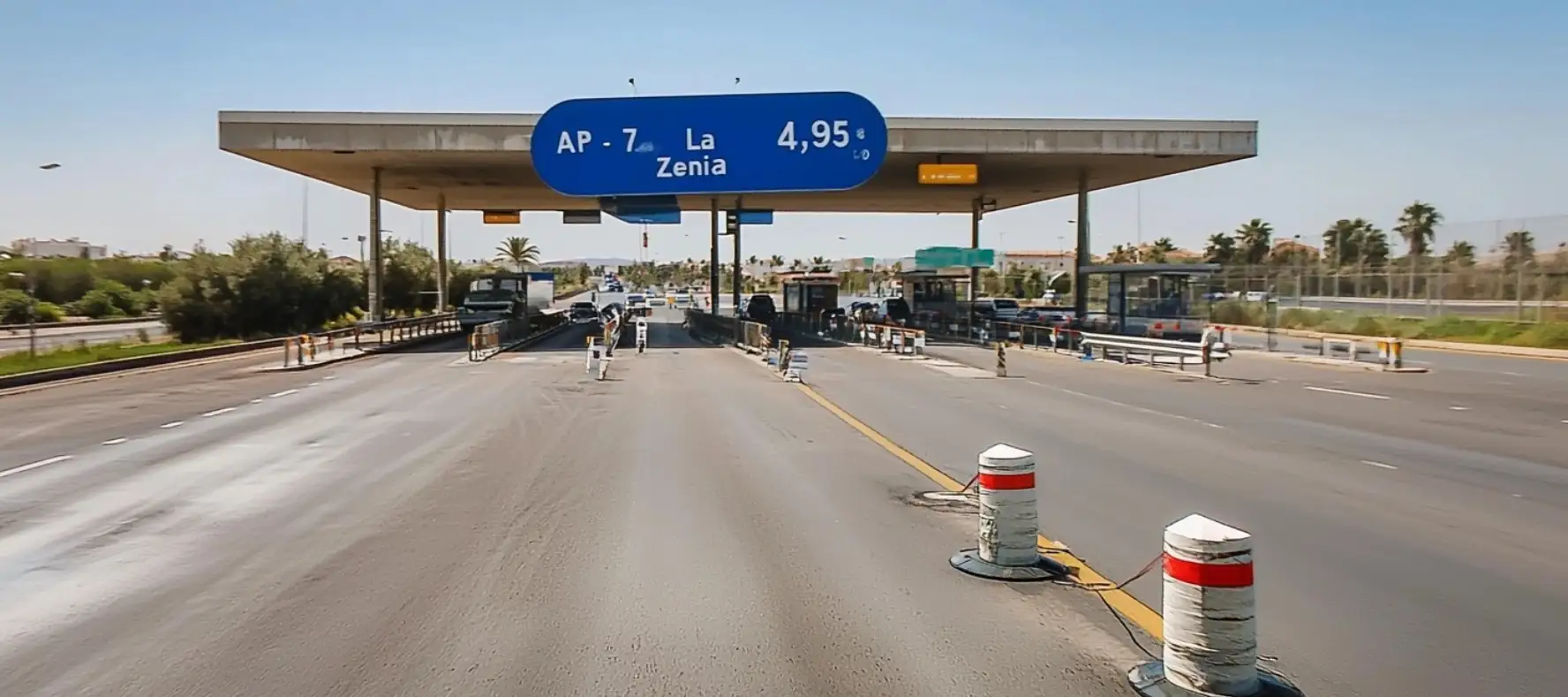
If you travel through Spain by car, you'll experience something special: on most motorways you drive completely free of charge. Especially on the popular Costa Blanca, many expats and holidaymakers wonder: "How can so many motorways be toll-free when every kilometre costs money in France or Italy?" The answer is not only interesting but also politically exciting – because Spain has successfully resisted the EU's toll plans several times. But be careful: there are a few exceptions, especially around the well-known La Zenia Mall.
No tolls in Spain? Well, sometimes there are
In recent years Spain has opened numerous toll roads (autopistas de peaje) to traffic free of charge. These included the AP-7 between Tarragona and Alicante as well as many other sections in Catalonia and Valencia. The concessions of private operators expired – and instead of extending them, the Spanish government decided to take them over and abolish the charges.
That was a clear signal to Brussels. As part of the recovery plan after the coronavirus crisis, the EU had urged Spain to introduce a uniform toll system. Spain, however, took a different path: it wanted to ease traffic, protect the environment and not burden drivers with further costs. In doing so, the country prevailed against the EU – at least for now.
How expensive is life really?
Toll-free motorways are just one advantage. Find out what life on the Costa Blanca costs you overall – from groceries and insurance to your car.
To the cost of living →The exception: the small toll section at La Zenia
If you're driving around the Alicante region, you'll notice it yourself: the AP-7 is free to use – with one exception. Between La Zenia Mall and the Peaje de Los Montesinos (Los Montesinos toll station) there is a short but chargeable section of around 12.5 kilometres. Here you currently pay (as of 2025) between €2.95 and €4.95 per entry or exit, depending on:
- whether you join directly at the mall or a little further south,
- whether you only drive part of the route or use the whole section,
- whether you use an automatic payment system,
- and which season or time of day you're travelling in.
Yes, you read that right: toll prices on this section vary – for example between the high season (summer holidays, Easter) and the low season (autumn, winter) as well as on public holidays or weekends.
What many people don't know: the AP-7 between Alicante and Cartagena is still under a private concession (operator: Autopista del Sureste, "Ausur"). The tariffs are set every year by the Spanish Ministry of Transport – with a considerably more expensive high-season tariff in summer and at Easter. For 2026, tariffs rose by up to 4.68%.
A particularly annoying point is the slip road directly at La Zenia Mall. Many drivers report paying €4.95 as soon as they join the AP-7 at the shopping mall – and just 12.5 kilometres further on, at the Peaje de Los Montesinos exit, another €4.95 is due. In total, that adds up to almost €10 for less than 15 minutes of driving. Many people – quite rightly – consider this disproportionate or even daylight robbery.
At the same time, other users report sometimes paying only €2.95 per section for the same route – for example in the low season or depending on the day of the week and time of day. Billing adjustments by automatic payment systems may also explain these price differences. Nevertheless, you're left with the impression that this small section – right in the middle of a tourist area – is deliberately designed to make you pay.
We ourselves have now driven this route dozens of times – and unfortunately we still can't say exactly why the prices fluctuate so much. For example, at the end of April and beginning of May, within just ten days, we paid €2.95 twice and €4.95 twice per toll station. Much of the variation, however, is explained by the official seasonal tariff (high and low season) that the Ministry of Transport sets every year. The fact is: if you join the AP-7 at La Zenia Mall, you have to pay. And if you don't manage to leave before the second barrier, you pay again. There's no escape in this case – which reinforces the impression that the section is geared towards maximum revenue.
Are there alternatives?
Yes! If you want to avoid the toll, you can switch to the well-developed N-332 national road. It runs parallel to the coast, through places such as Guardamar, Torrevieja, La Zenia, Pilar de la Horadada or Santa Pola, and is especially popular with locals. The A-7 inland is also completely toll-free and takes you along the Costa Blanca without major detours.
However: during the holidays or at weekends the N-332 can get congested. If you want to get from A to B quickly, you may prefer to use the short toll section after all – especially if you're heading to La Zenia Mall, Alicante airport or the motorway to Murcia.
Spain as a special case for tolls in Europe
While countries such as France, Italy or Austria operate a dense network of toll motorways, Spain goes its own way.
Today the vast majority of Spanish motorways are toll-free – only individual concession routes still charge tolls. That's a real advantage not only for holidaymakers but also for expats who regularly commute between home, work or the airport. So if you settle permanently on the Costa Blanca, you benefit enormously in everyday life – the cost of living in Spain is noticeably reduced by the largely toll-free roads.
But note: some routes around Madrid, in tunnels, near San Sebastián or in the Basque Country may still be subject to tolls. So it's worth taking a quick look at Google Maps or the app of the Spanish motorway authority before any longer journey.
Conclusion
If you're moving to the Costa Blanca or regularly travel around here, you can be pleased: most motorways in Spain are free – the route from Murcia to Alicante is toll-free via the A-7 autovía (through Orihuela and Elche) – you only pay if you take the coastal AP-7 towards Torrevieja/Cartagena.
Only the section at La Zenia, more precisely between the slip road at La Zenia Shopping Mall and the Peaje de Los Montesinos, is a reminder that Spain once relied on toll systems. And perhaps also a reminder that it's sometimes good when a country doesn't blindly adopt every EU proposal.
Via-T is not an app but an electronic toll tag (Telepeaje), offered e.g. by Spanish banks – if you use one, check your bank account for automatically charged tolls. And if you want to be completely sure: simply take the N-332 along the coast – it takes longer but costs nothing.
Any questions?
Carlo Reuss has 22 years of experience living abroad, 10 of them in Spain. Have a question about this topic? Send it to us via the contact form.
Ask a question →Frequently asked questions about tolls on the Costa Blanca
How much is the toll at La Zenia on the AP-7?
Depending on the season, time of day and route, you pay between €2.95 and €4.95 per section. Between La Zenia Mall and the Peaje de Los Montesinos in particular, this can add up to €9.90 for just 12.5 kilometres.
Why do the toll prices vary so much?
Mainly because of the season: the Ministry of Transport sets the tariffs every year, with a considerably more expensive high-season tariff in summer and at Easter. Automatic billing systems can also lead to differences.
Can you avoid the toll at La Zenia?
Yes, via the toll-free N-332 national road along the coast or via the A-7 inland. However, you should expect more traffic and a longer journey time.
Are there official sources for current toll prices?
Tariffs are set annually by ministerial order (published in the BOE, Spain's official gazette): in the high season (summer and Easter) the AP-7 Alicante–Cartagena costs around 80% more than during the rest of the year. You pay at the toll station in cash, by card or with a Vía-T device.
Will the tolls on the Costa Blanca be abolished?
Many sections of the AP-7 are now toll-free because the concessions have expired. The area around La Zenia, however, is still privately operated and will remain subject to tolls for the foreseeable future.


Planning your move to the Costa Blanca?
Our guides cover the key steps — from the NIE number and residency to buying property.
Start with the NIE guidePersonal questions: new requests via the consultation page are currently paused.