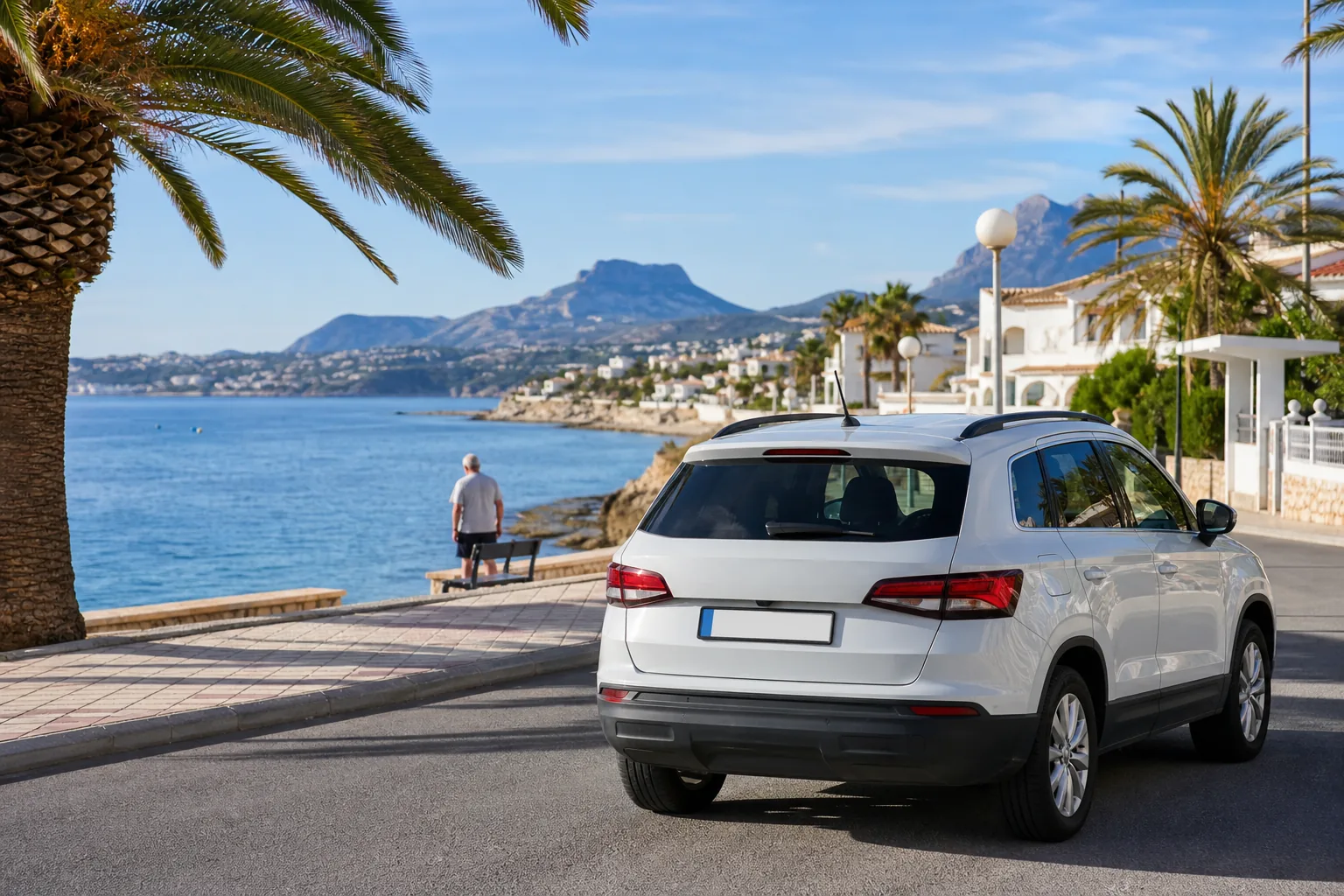






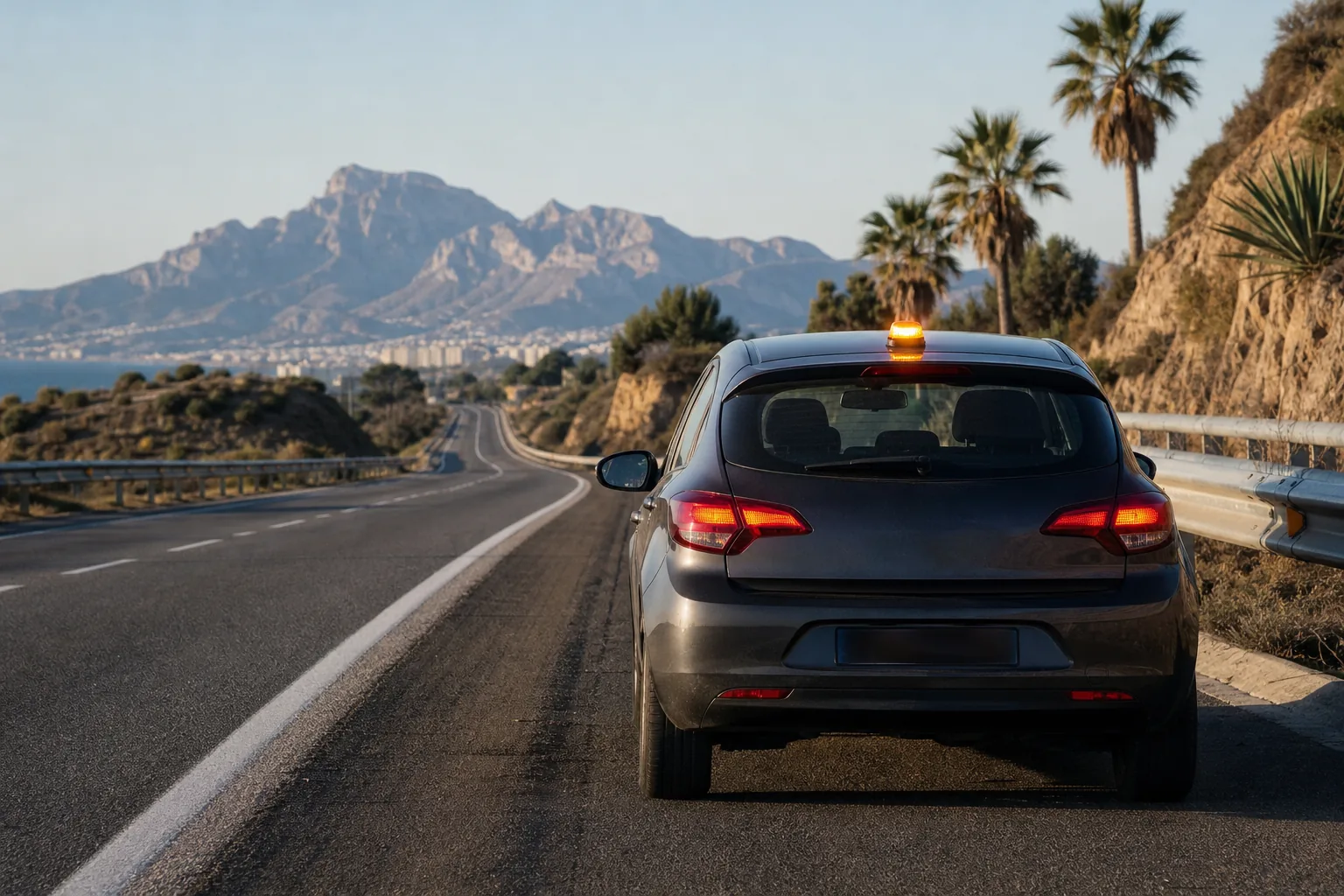
Summer 2026, early in the morning: family had been visiting and were flying home from Alicante. My partner was driving them to the airport in our car – Spanish plates, Spanish car insurance, nothing unusual. Halfway there the engine warning light came on and the temperature shot up. What happened next genuinely surprised me: towed within 35 minutes, repaired in about 24 hours, for €521.
Here is the whole story – and at the end a checklist of what to do if you break down in Spain.
What happened
My partner pulled onto the hard shoulder and called me. The engine was overheating, so: engine off, let it cool down briefly, then drive the short distance to the next exit near Elche and park safely there.
At that moment the biggest problem wasn't the car but the flight. I called a taxi company in Elche. First they said "the taxi is on its way"; ten minutes later, when I checked: no taxi after all. Uber, on the other hand, arrived within five minutes and took the family to the airport. They made their flight.
Tip: If you're in a hurry, don't rely on a taxi alone. Around Alicante and Elche, Uber worked quickly and reliably for us.
Towed in 35 minutes – through the car insurance
Next I called the breakdown service of my Spanish car insurance. This is how it went:
- The hotline works in English too – I tried it, no problem at all. Good to know if your Spanish isn't there (yet). I said where the car was and what had happened.
- I got a link by text message that let me watch the tow truck live as it got closer.
- 35 minutes after my call it was there.
- It took the car to the garage of my choice – about 20 km away in Crevillent.
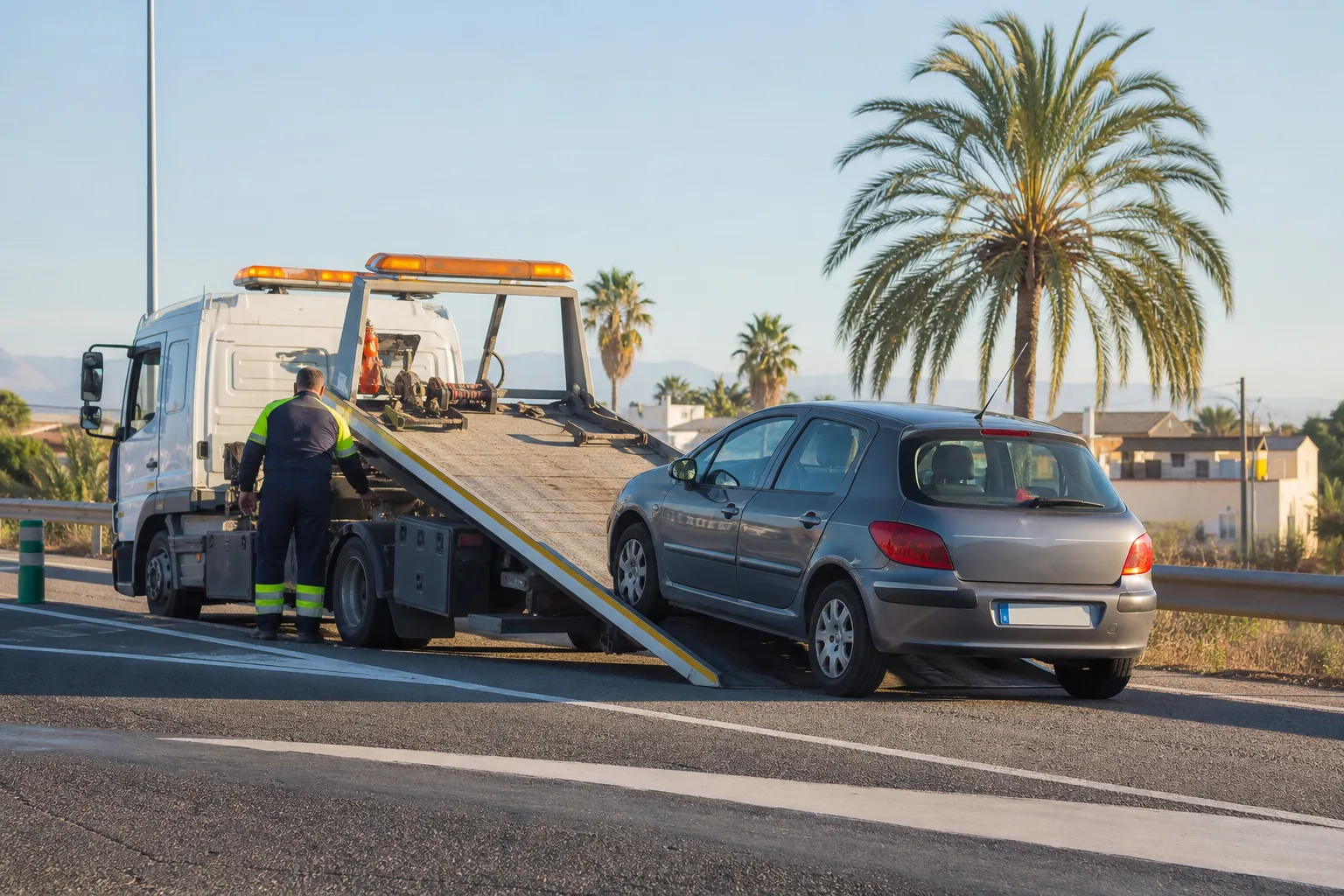
In our case it was MAPFRE. But that's nothing unique: many Spanish car insurers include breakdown cover, and other insurers also let you track the tow truck live. What matters is whether breakdown cover is part of your policy, whether it also applies if the car won't start at home (in Spain this is called “asistencia desde el kilómetro 0”) and how far the tow truck will take you.
You can find the insurance that suits you on price and cover through us – in three minutes: Car insurance in Spain: calculate your price and request a quote.
For comparison: Cologne, 2025
A real case from our circle of friends, Cologne 2025: the car wouldn't start. He's a member of the ADAC (Germany's big automobile club), called them – and waited three hours, only to then wait again for a tow truck.
That's one case, not a test. But the difference from our 35 minutes one morning near Elche is striking.
Repaired in 24 hours
The car arrived at the garage around 11 am; the next day at noon it was ready.
What was broken: the water pump – that's why the engine was no longer cooling properly and overheated. On this engine the timing belt drives the water pump. Because the timing belt would have been due soon anyway and the garage was working on that part already, they replaced it at the same time. That's standard practice – and saves a second repair later.
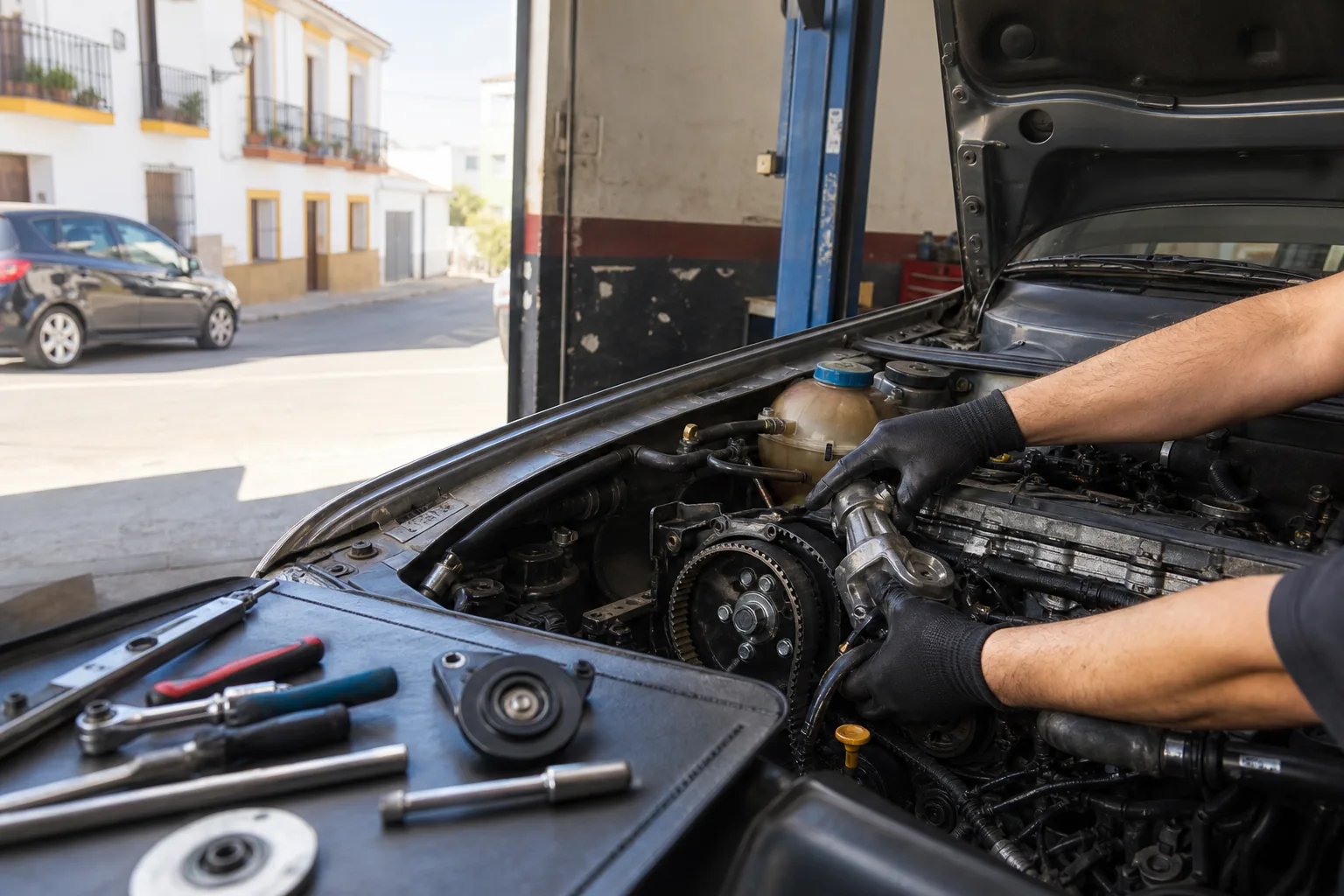
This is what the bill looked like (recreated, Skoda Octavia, about 132,700 km):
| Item | Amount |
|---|---|
| Labour: replace timing belt kit with water pump, new coolant, bleed the cooling system (5 h × €37.50) | €187.50 |
| Timing belt kit with water pump | €196.65 |
| Auxiliary drive belt | €19.83 |
| Coolant G12 EVO (5 × €4.60) | €23.00 |
| Cleaning spray | €4.00 |
| Subtotal before tax | €430.98 |
| VAT (IVA 21%) | €90.51 |
| Total | €521.49 |
What would it have cost in Germany?
For a timing belt change with water pump on a Skoda Octavia, German comparison sites quote prices from around €650, and from €1,075 for some models. Realistically – including VAT and depending on engine and garage – we'd expect €900 to €1,600 in Germany. We paid €521: roughly a third to just over half, depending on the comparison.
The hourly rate is even more telling: according to the German insurers' association GDV, an hour in a German garage now costs around €200 on average. Our garage charged €37.50 per hour – €45.38 including tax. That's less than a quarter.
On top of that, the tow and the 20 km to the garage of our choice cost us nothing extra, because breakdown cover was included in the insurance.
The garage
The repair was done by ExpressCar in Crevillent, an independent garage. Only Spanish is spoken there.
To be fair: it doesn't always go this smoothly, and not everywhere. How quickly the tow truck arrives and how fast the repair is done depends on the region, the time of day, the garage and your own network on the ground.
Breaking down in Spain: checklist and mandatory equipment 2026
Everything to tick off – with emergency number, a location button for the breakdown service and what has to be in the car since 2026. The key change: since 1 January 2026 the connected V16 warning light replaces the warning triangle.
Checklist to tick off
Breaking down in Spain: step by step
Save this page – if it happens, you have everything at a glance.
You can give these coordinates to the breakdown service. Your location stays on your phone – we store nothing.
What must be in the car in 2026
For cars with Spanish plates. As of November 2026.
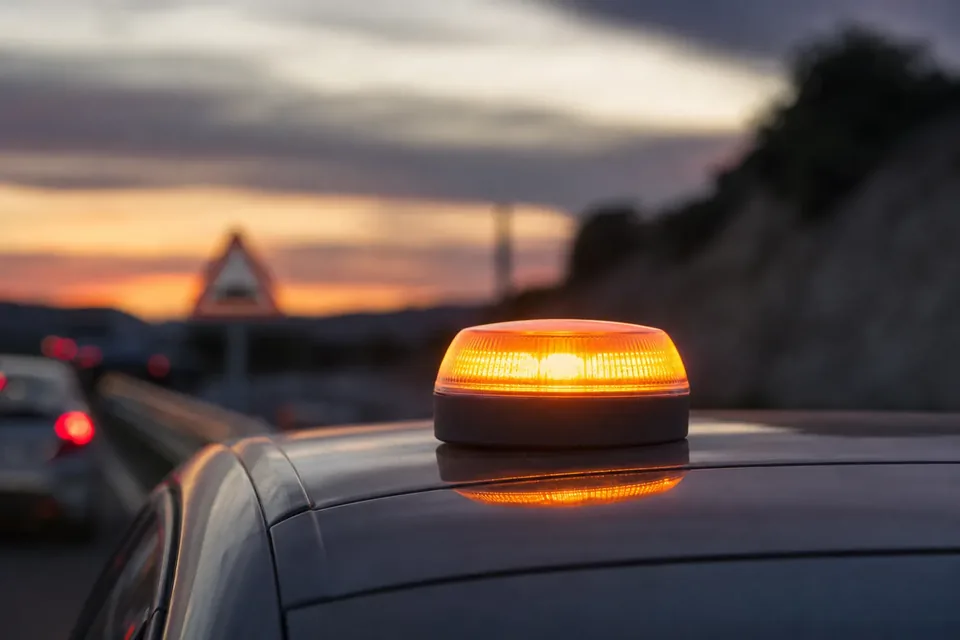
V16 warning light (connected)
Replaces the warning triangle. Only DGT-approved models with a data connection count – older V16 lights without a connection are no longer valid. Without a valid light you risk an €80 fine.
🦺 Hi-vis vest
Within reach inside the car, not in the boot – you put it on before getting out.
🔺 Warning triangle
May still be used in addition to the V16. Cars with foreign plates may keep using triangles.
📄 Documents
Driving licence, registration certificate (permiso de circulación) and ITV card – originals or digitally in the miDGT app.
🛞 Spare wheel or repair kit
Whether it is mandatory is interpreted differently – but without one you are stuck with a flat tyre.
📱 Breakdown number
Save it in your phone and install your insurer’s app – it often lets you track the tow truck live.
Read more
- Driving on the Costa Blanca – everything you need to know
- ITV on the Costa Blanca: process, costs & importing a car
- Car insurance in Spain: calculate your price and request a quote
Sources
- DGT: Pflicht zur V-16-Warnleuchte (Pressemitteilung 25.11.2025)
- MAPFRE: Asistencia en carretera – Abschlepper anfordern und live verfolgen
- Zurich: Geolocalización de la grúa (Live-Ortung des Abschleppers)
- Repareo: Zahnriemenwechsel Skoda – Kosten
- carwiki: Zahnriemenwechsel Skoda Octavia
- FairGarage: Zahnriemenwechsel bei einem Skoda
- AUTOHAUS: Stundensatz von Kfz-Werkstätten erstmals über 200 Euro (GDV)
- Ministerio del Interior / La Moncloa: Baliza V16 conectada – Pflicht ab 1.1.2026, Ausnahme ausländische Kennzeichen
- carwow: DGT – Warndreiecke dürfen zusätzlich zur V16 genutzt werden
- El Español: Ersatzrad laut Reglamento General de Vehículos nicht ausdrücklich Pflicht (04/2026)


 Written by Carlo Reuss22 years living abroad, 10 of them in Spain. About me →
Write to us – we answer or connect you with the right people.
Ask a question →